2026 Georgia Scientific Computing Symposium
Saturday, February 21, 2026
Physics Building 202, University of Georgia
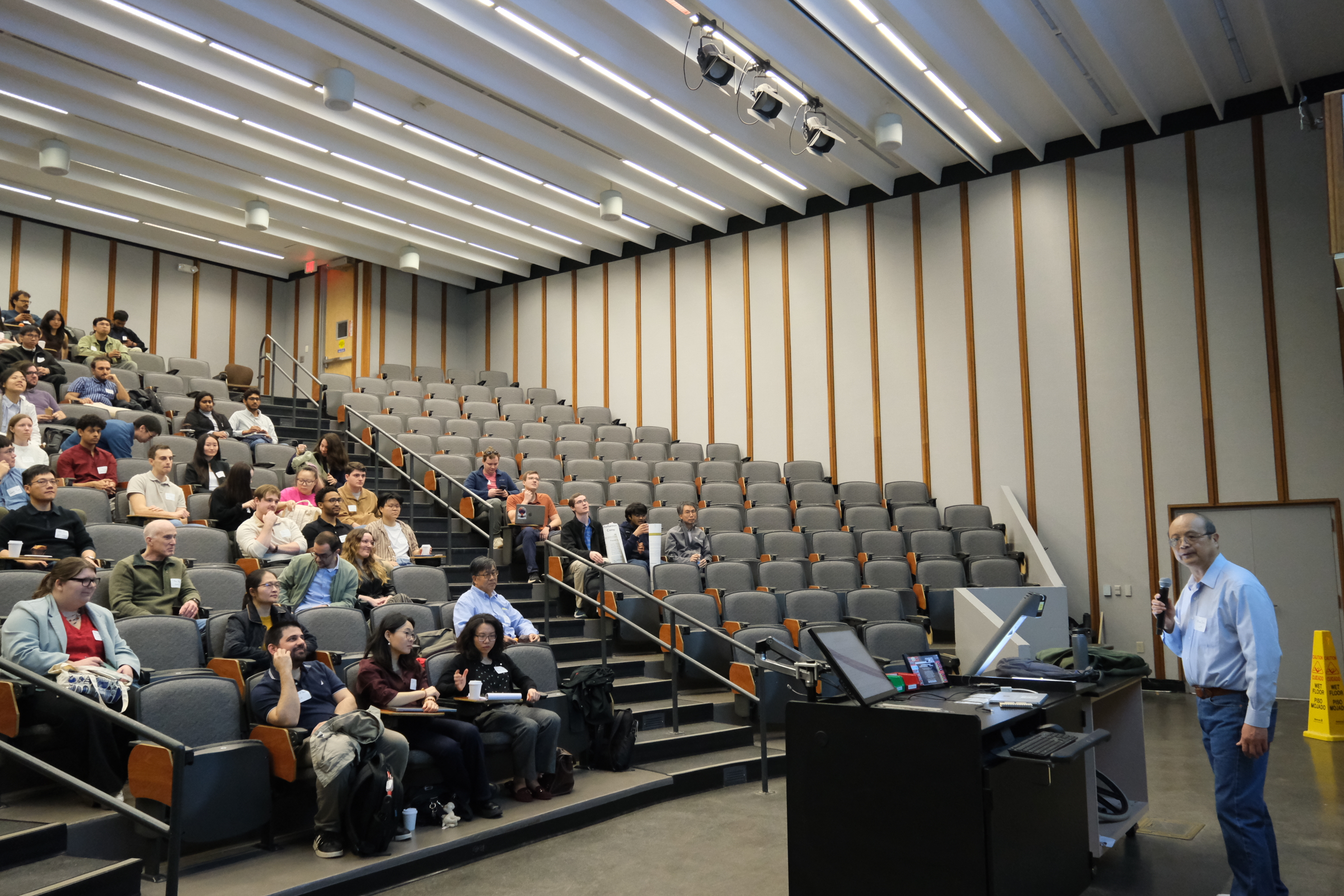
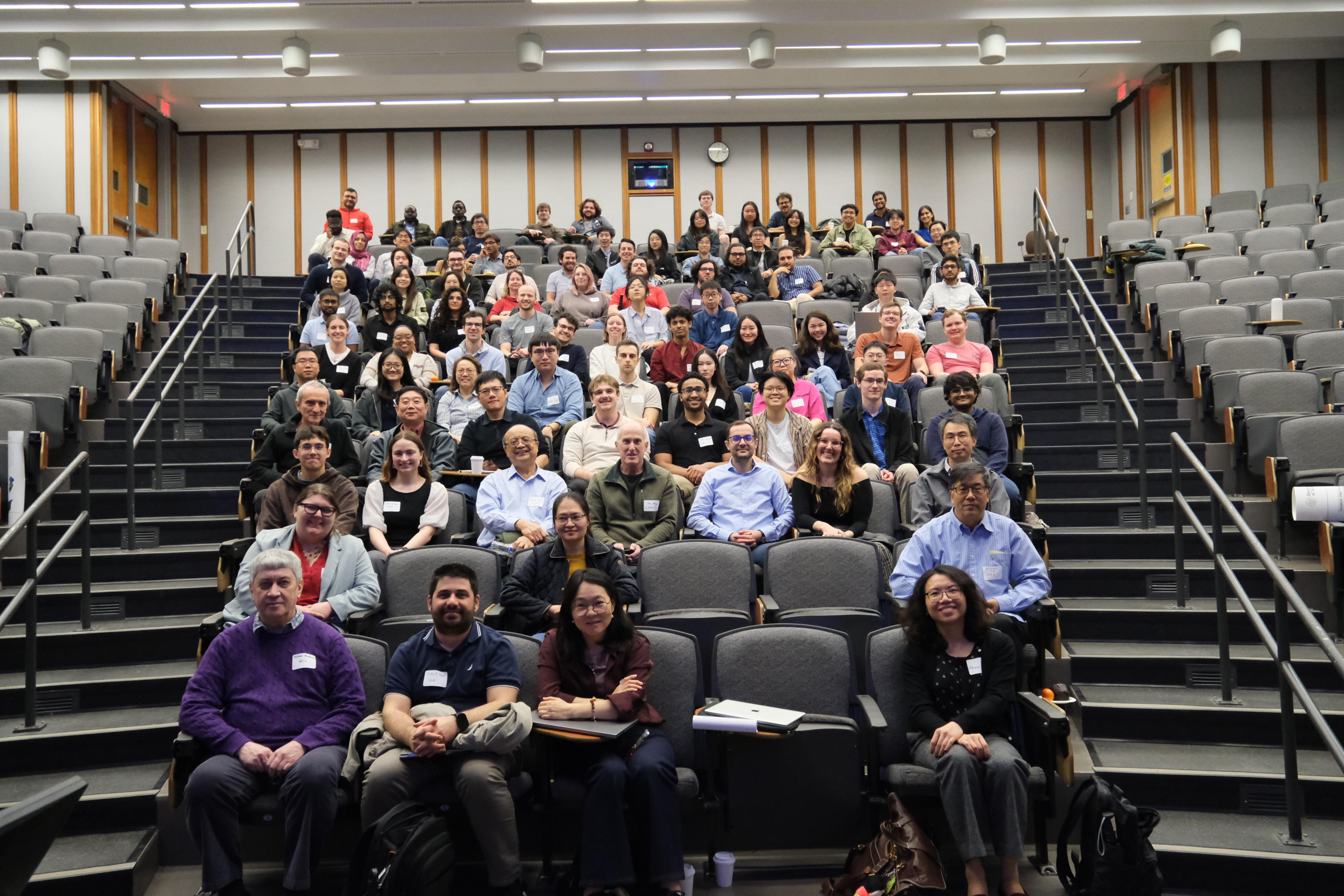
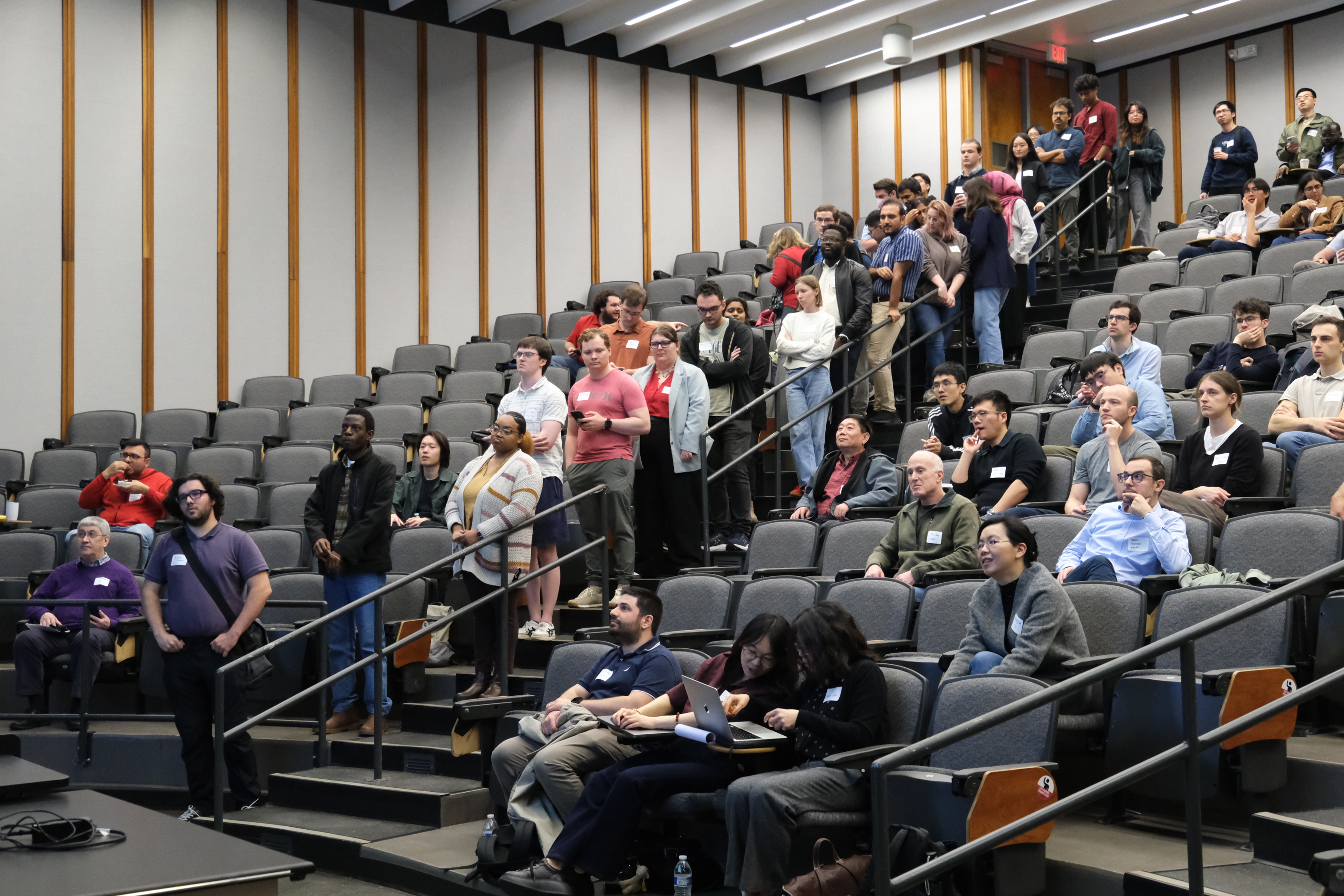
Welcome to visit Athens again!
The Georgia Scientific Computing Symposium is a forum for professors, postdocs, graduate students and other researchers in Georgia to meet in an informal setting, to exchange ideas, and to highlight local scientific computing research. Held every year since 2009, the symposium welcomes the entire research community. This year’s event will take place on Saturday, February 21, 2026, at the University of Georgia. The day-long program will feature invited talks, poster sessions with a “poster blitz,” and ample opportunities for networking.
Registration is now closed. For registration inquiries, please contact Hao-Ning Wu at hnwu@uga.edu.
Plenary Speakers
- Ming-Jun Lai, University of Georgia
- Marco Tezzele, Emory University
- Helen Xu, Georgia Institute of Technology, CSE
- Chi-Kuang Yeh, Georgia State University
- Haomin Zhou, Georgia Institute of Technology, Math
Poster Sessions
Poster presentations are open to all; we especially welcome graduate students and postdocs to advertise their work. To participate, please include your poster title in the registration form. You’ll also be invited to our Poster Blitz for a one-minute, one-slide preview.
Schedule
| 8:30–9:00 | Registration | |
| 9:00–9:10 | Welcome remarks | |
| 9:10–9:50 |
Ming-Jun Lai University of Georgia |
Multivariate splines and their classic and modern applications |
| 9:50–10:30 |
Marco Tezzele Emory University |
Predictive digital twins based on graphical models: From infrastructure management to on-orbit operations |
| 10:30–10:50 | Coffee | |
| 10:50–11:30 |
Poster Blitz
1. Abir Haque (GT) – Massively parallel random phase approximation correlation energy via Lanczos quadrature
2. Aidan Tillman (GSU) – Impact of stochasticity on dynamic entrainment in a neuronal spiking model 3. Angelo Kwaku Boateng (GSU) – Rate-selective synchronization in switching networks: when timing meets structure 4. Ansley Bentley (Emory) – Randomized hybrid projection methods with recycling for inverse problems 5. Antonio Varagnolo (GT) – Physics-enhanced deep surrogates for the phonon Boltzmann transport equation 6. Ben Burns (GT) – Infinite-dimensional Stein variational inference with derivative-informed neural operators 7. Ben Wilfong (GT) – Shocks without shock capturing; compressible flow at 1 quadrillion degrees of freedom without loss of accuracy 8. Chloe Maitrejean (GSU) – Flight stability of cones and wedges 9. Daniel Vickers (GT) – Highly-parallel fluid-solid interactions for compressible flows 10. Davide Elia De Falco (SSM/Emory) – ELMs with space-time collocation for the numerical resolution of parabolic PDEs 11. Dilmini Warnakulasooriya (GSU) – Comparative analysis of β-adrenergic stimulation of myocyte contraction by different agonists 12. Elle Buser (Emory) – Computational methods for hyperparameter estimation with applications to separable nonlinear inverse problems 13. Emeka Mazi (GSU) – Transform method for modeling erosion analysis with cylindrical bodies in channel flow 14. Eric Fowler (GT) – High-performance tensor contractions in computational chemistry 15. Hamed Karami (GSU) – Modeling and control of highly pathogenic avian influenza in poultry using network disease dynamics 16. Haoran Yan (GT) – Understanding denoising autoencoders through the manifold hypothesis: a geometric perspective 17. Jiuru Lyu (Emory) – Test double descent with color intermittent diffusion (DD-CID) with challenges in different disciplines 18. Justyna Sokolik (GSU) – Network model of tissue engineering scaffolds 19. Kashvi Mundra (GT) – Autoregressive multifidelity neural surrogate modeling under scarce data regimes 20. Katherine Keegan (Emory) – Manifold-aware perturbations for constrained generative modeling 21. Lawan Wijayasooriya (GSU) – Dynamic entrainment for optimal pulse timing in Morris-Lecar model 22. Marrium Shamshad (GSU) – Aperiodic 1/f fingerprints of excitation–inhibition balance in human epilepsy 23. Max Collins (Emory) – Latent twins: learning physical systems from data 24. Mitchell Scott (Emory) – What makes a good preconditioner for data science? 25. Riley Yizhou Chen (Emory) – Variable projected augmented Lagrangian methods for generalized Lasso problems 26. Sebastian Gutierrez Herandez (GT) – PDPO: parametric density path optimization 27. Srijon Sarkar (Emory) – Kronecker approximations of covariance matrices for solving inverse problems 28. Tommy Stell (GSU) – Commitment issues in motoneurons: how ionic currents enable bistability 29. Umma Hafsah Himu (GSU) – Statistical meta-analysis to investigate the association of SNP (rs4680) in COMT gene with multiple cancers 30. Vivian Zhang (GT) – Multifidelity operator inference: non-intrusive reduced order modeling from scarce data 31. Xian Hadia (GT) – Data efficiency of surrogate models: learning physics data from full field data vs. inductive bias from approximate PDE solvers 32. Xiangming Huang (GT) – Neural operator accelerated evolutionary strategies for PDE-constraint optimization 33. Xu (Melissa) Wang (Emory) – A primal-dual price-optimization method for computing equilibrium prices in mean-field games models 34. Yiran Xu (GSU) – Nationwide epidemiologic and cost burden analysis of chemotherapy-induced neurological disorders 35. Zhaiming Shen (GT) – Understanding in-context learning on structured manifolds: bridging attention to kernel methods 36. Zhongjie Shi (GT) – Towards understanding generalization in DP-GD: a case study in training two-layer CNNs |
|
| 11:30–12:30 | Poster Session | |
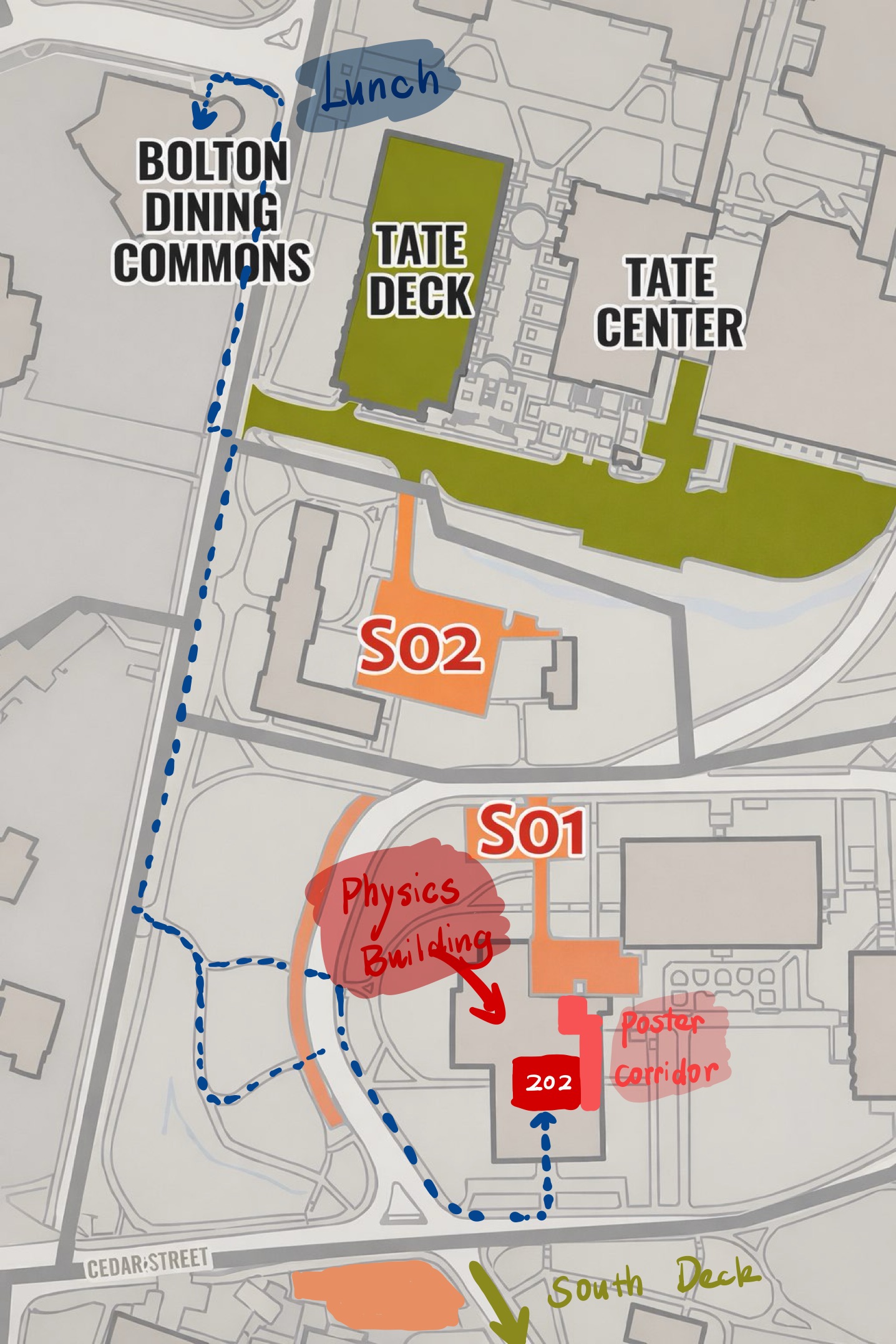
| 12:30–14:00 | Lunch at Bolton Dining Commons | |
| 14:00–14:40 |
Helen Xu Georgia Tech, CSE |
Optimizing data movement in sparse computations via cache-friendly layouts |
| 14:40–15:20 |
Chi-Kuang Yeh Georgia State University |
Single and multi-objective optimal designs for group testing experiments |
| 15:20–15:40 | Coffee | |
| 15:40–16:20 |
Haomin Zhou Georgia Tech, Math |
A parameterized Wasserstein Hamiltonian flow approach for solving the Schrödinger equation |
Local Information
- Lunch will be served at Bolton Dining Commons. Complimentary admission tickets will be provided to all attendees at the conference reception.
- Parking is free on weekends per UGA parking policy. The address of the Physics Building is 220 Cedar Street, Athens, GA 30602. We recommend parking in the S1 Parking Lot or nearby lots (highlighted in orange). If it is full, alternative options include the Tate Center Deck and the South Deck.
- Local Guide visitathensga.com
Participants
List of Participants (click to expand)
- Sheriff Akeeb, Georgia State University
- Mohammed S. Al-Mahrouqi, Georgia Institute of Technology
- Brighton Ancelin, Georgia Institute of Technology
- Clara Armstrong, Emory University
- Taiwo Ayeni, Georgia State University
- Asma Azizi, Kennesaw State University
- Mamoun Benchekroun, Georgia Institute of Technology
- Ansley Bentley, Emory University
- Christeen Bisnath, Georgia State University
- Angelo Kwaku Boateng, Georgia State University
- Vladimir E. Bondarenko, Georgia State University
- Alex Brower, University of Georgia
- Audrey Bu, Emory University
- Benjamin Burns, Georgia Institute of Technology
- Elle Buser, Emory University
- Alina Chen, Emory University
- Riley Yizhou Chen, Emory University
- Sifur Safuka Chowdhury, Georgia State University
- Allison Chung, Georgia Institute of Technology
- Max Collins, Emory University
- Luca Dieci, Georgia Institute of Technology
- Chelsea Drum, Emory University
- Jacob Eiermann, University of Georgia
- Davide Elia De Falco, Scuola Superiore Meridionale
- Caleb Fikes, Emory University
- Eric Fowler, Georgia Institute of Technology
- Kaine Griffin, University of Georgia
- Viktorya Grigoryan, Emory University
- Sebastián Gutiérrez Hernández, Georgia Institute of Technology
- Dan Ha, Georgia Institute of Technology
- Xian Hadia, Georgia Institute of Technology
- Abir Haque, Georgia Institute of Technology
- Cuiyu He, University of Georgia
- Umma Hafsah Himu, Georgia State University
- Weiwei Hu, University of Georgia
- Xiangming Huang, Georgia Institute of Technology
- Russell Jeter, Georgia State University
- Tiffany Jin, Emory University
- Sung-Ha Kang, Georgia Institute of Technology
- Hamed Karami, Georgia State University
- Caner Kazanci, University of Georgia
- Katherine Keegan, Emory University
- Steven Kesser, University of Georgia
- Andrew Krause, Georgia State University
- Ming-Jun Lai, University of Georgia
- Meixi Li, Georgia Institute of Technology
- Stephanie Li, Georgia Institute of Technology
- Yang Li, Georgia State University
- Wenjing Liao, Georgia Institute of Technology
- Tongtong Liu, University of Georgia
- Yicong Luo, Georgia Institute of Technology
- Jiuru Lyu, Emory University
- Chloe Maitrejean, Georgia State University
- Manuela Manetta, Emory University
- Talea Mayo, Emory University
- Emeka Mazi, Georgia State University
- Leslie J. Meadows, Georgia State University
- Bakhshi Mehul, Georgia Institute of Technology
- Mohammed Altayeb Yagoub Mohammed, Georgia State University
- Leonardo Molinari, Emory University
- Lin Mu, University of Georgia
- Kashvi Mundra, Georgia Institute of Technology
- Jim Nagy, Emory University
- Toby Viet Nguyen, Georgia Institute of Technology
- Levon Nurbekyan, Emory University
- Lucas Onisk, Emory University
- Valerio Palamara, University of Georgia
- João M Pereira, University of Georgia
- Joe Rao, Georgia Institute of Technology
- Somiya Rauf, Georgia State University
- Haley Rosso, Emory University
- A Saha, Georgia Institute of Technology
- Akshita Sahni, Georgia Institute of Technology
- Pejman Sanaei, Georgia State University
- Srijon Sarkar, Emory University
- Mitchell Scott, Emory University
- Marrium Shamshad, Georgia State University
- Kaichen Shen, Georgia Institute of Technology
- Zhaiming Shen, Georgia Institute of Technology
- Zhongjie Shi, Georgia Institute of Technology
- Martin Short, Georgia Institute of Technology
- Ruiwen Shu, University of Georgia
- Amy María Sims, Georgia State University
- Sindhoora, Georgia Institute of Technology
- Kevin Slote, Clarkson University
- Justyna Sokolik, Georgia State University
- Jack Michael Solomon, Emory University
- Tommy Stell, Georgia State University
- Marco Tezzele, Emory University
- Alex Tian, Georgia Institute of Technology
- Ye Tian, University of Georgia
- Aidan Tillman, Georgia State University
- Antonio Varagnolo, Georgia Institute of Technology
- Alessandro Veneziani, Emory University
- Deepanshu Verma, Clemson University
- Daniel Vickers, Georgia Institute of Technology
- Ishita Vohra, Georgia Institute of Technology
- Ha Vu, Georgia State University
- Xinning Wang, Georgia State University
- Xu Wang, Emory University
- Yan Wang, University of Georgia
- Dilmini Warnkulasooriya, Georgia State University
- Warin Watson, Emory University
- Tharindu Wijayalath, Kennesaw State University
- Lawan Wijayasooriya, Georgia State University
- Ben Wilfong, Georgia Institute of Technology
- Joseph Woods, Emory University
- Hao-Ning Wu, University of Georgia
- Helen Xu, Georgia Institute of Technology
- Tianshi Xu, Emory University
- Yiran Xu, Georgia State University
- Haoran Yan, Georgia Institute of Technology
- Huanhuan Yang, Central China Normal University
- Jiaqi Yang, Emory University
- Yahong Yang, Georgia Institute of Technology
- Chi-Kuang Yeh, Georgia State University
- Benjamin Yellin, Emory University
- Vivian Zhang, Georgia Institute of Technology
- Zhe Zhong, Georgia State University
- Haomin Zhou, Georgia Institute of Technology
- Wei Zhu, Georgia Institute of Technology
Organizers
- Weiwei Hu, University of Georgia
- Ming-Jun Lai, University of Georgia
- Lin Mu, University of Georgia
- João M Pereira, University of Georgia
- Hao-Ning Wu, University of Georgia
Sponsored by the Simons Foundation Collaboration Grant #854439.
Previous GSCS
- 2025 GSCS at Georgia Institute of Technology, Math
- 2024 GSCS at Emory University
- 2023 GSCS at Georgia State University
- 2022 GSCS at Georgia Institute of Technology, CSE
- 2021 GSCS at University of Georgia (Virtual)
- 2020 GSCS at Emory University
- 2019 GSCS at Georgia Institute of Technology, Math
- 2018 GSCS at Georgia State University
- 2017 GSCS at University of Georgia
- 2016 GSCS at Emory University
- 2015 GSCS at Georgia Institute of Technology, CSE
- 2014 GSCS at Kennesaw State University
- 2013 GSCS at Georgia State University
- 2012 GSCS at University of Georgia
- 2011 GSCS at Emory University
- 2010 GSCS at Georgia Institute of Technology
- 2009 GSCS at Emory University